



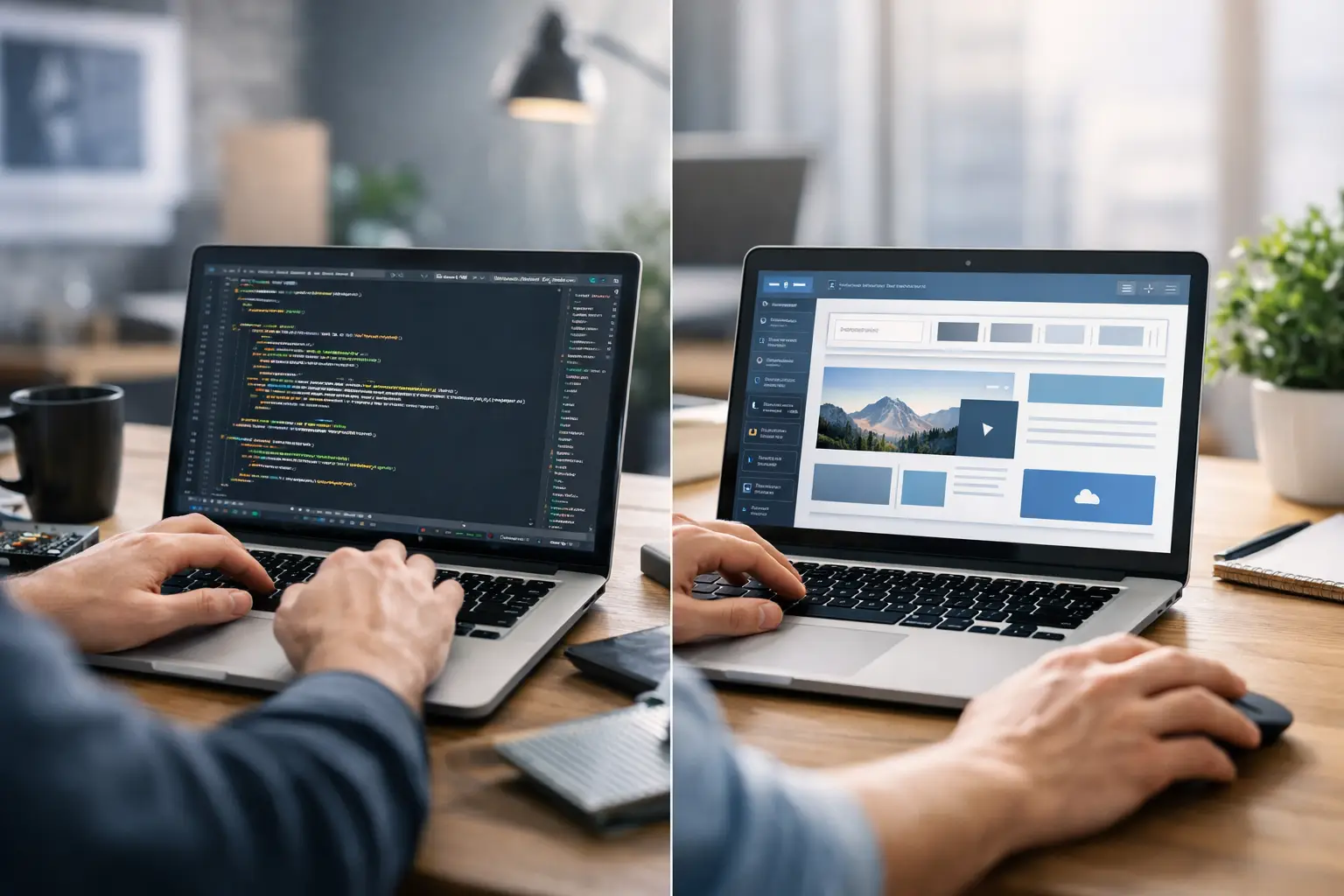
A lot of business owners only ask about website design after something starts breaking – slow load times, weak rankings, poor mobile performance, or a site that looks fine but does not bring in leads. That is where the real custom code vs page builders conversation starts. It is not just about how a website gets built. It is about whether your site can support marketing, conversions, and growth without creating headaches later.
If you run a law firm, medical practice, roofing company, or local service business, your website is not a digital brochure. It is part of your sales process. The right build approach can help you rank better, convert more visitors, and adapt faster when your business changes. The wrong one can box you in.
Custom code vs page builders: the real difference
Page builders are visual website tools that let users create pages with drag-and-drop modules. They are popular because they are fast to launch and easier for non-developers to manage. For a simple site with basic needs, that can be enough.
Custom code means the site is developed with more direct control over the structure, functionality, and performance. Instead of relying on prebuilt blocks and heavy third-party systems, developers build around the exact needs of the business. That usually takes more planning and more technical skill, but it creates a stronger foundation.
This is why the comparison gets misunderstood. Many people frame it as easy versus hard, or cheap versus expensive. In practice, it is more like short-term convenience versus long-term control.
When page builders make sense
Page builders are not bad. They solve real problems for businesses that need a site live quickly and do not require custom workflows, advanced integrations, or high-performance optimization.
If you are a newer company testing an offer, launching a temporary campaign, or building a brochure-style site with a limited budget, a page builder can be a practical starting point. It allows content changes without needing a developer for every update. That flexibility appeals to many small teams.
They can also work well when internal staff want to edit text, swap images, or create new landing pages on their own. For some businesses, that convenience matters more than technical perfection.
The catch is that page builders often add extra code behind the scenes. That can affect speed, mobile experience, and stability over time. What starts as a simple site can become harder to maintain once plugins pile up, templates get modified, and marketing tools need to connect cleanly.
Where page builders start to hurt performance
Most business owners do not notice the downside of page builders on day one. They notice it six months later when pages feel sluggish, forms stop working properly, or SEO gains stall despite ongoing marketing.
A big issue is code bloat. Drag-and-drop tools often generate far more markup and scripts than the page actually needs. Search engines can still crawl these sites, but performance often suffers. If your business depends on local SEO, paid traffic, or mobile leads, those delays matter.
Another issue is design and functional limits. A builder may let you create a page that looks close enough to what you want, but close enough is not always good enough when conversion rates are on the line. If your sales process depends on custom forms, dynamic content, API connections, scheduling systems, or unique user flows, you can hit the builder’s ceiling fast.
Then there is maintenance. The more your site relies on themes, add-ons, and third-party widgets, the more moving parts you need to monitor. One plugin conflict can affect layout, speed, or lead capture. That is not a small problem when your website supports active marketing campaigns.
Why custom code gives growing businesses an edge
Custom code is usually the stronger choice when a website needs to do more than exist. If the goal is lead generation, better rankings, faster load times, cleaner tracking, and tighter integration with business systems, custom development gives you room to build correctly from the start.
The first advantage is performance. A hand-coded site can be built with only the assets and functionality it actually needs. That means cleaner code, faster pages, and a better user experience across devices. Speed alone will not fix a weak marketing strategy, but it removes friction that hurts traffic and conversions.
The second advantage is flexibility. A custom site is not limited to what a builder happens to support. If you need a specialized quote form, CRM integration, customer portal, advanced location pages, or automation logic tied to how leads move through your business, custom code makes that possible.
The third advantage is scalability. Businesses rarely stay static. You may add services, locations, campaigns, team members, or backend processes over time. A custom foundation makes those changes easier to plan for, rather than patching around limitations every time you grow.
For agencies like Mindful Coding Solutions, this is where technical depth matters. Marketing execution works better when the underlying site is not fighting against the strategy.
The SEO impact of custom code vs page builders
From an SEO standpoint, both approaches can rank. That is the honest answer. A page builder site can rank well if content, structure, local relevance, and authority are strong.
But custom code often creates a cleaner environment for SEO work. Developers can control heading structure, schema implementation, internal page architecture, image handling, lazy loading, and script management with much more precision. That level of control matters when you are competing in crowded local markets.
If your business depends on organic traffic, technical details are not minor. A slow site, poor Core Web Vitals, messy code, and weak mobile usability can drag down otherwise solid SEO work. Custom development does not guarantee rankings, but it can remove technical barriers that page builders often introduce.
This is especially relevant for service businesses targeting multiple cities or specialties. Custom builds make it easier to create scalable content frameworks without forcing every page through the same rigid template structure.
Cost is not just the build price
The biggest reason businesses choose page builders is cost. Up front, that decision often makes sense. A custom-coded site typically requires more time, strategy, and specialized work.
But the smarter question is total cost over time. If a lower-cost builder site loads slowly, limits SEO growth, breaks under plugin conflicts, or needs a rebuild once your marketing matures, the savings disappear quickly.
Custom code usually costs more at the beginning because you are paying for a stronger asset, not just a faster launch. That said, not every business needs the most advanced solution right away. A small company with a simple service area and light functionality may be better served by starting lean and upgrading later.
That is why this decision should be tied to business goals, not trends. If your site is meant to support aggressive lead generation, multi-channel marketing, and long-term growth, a stronger technical foundation is often the better investment.
How to choose the right option for your business
Start with what the website actually needs to do. If you mainly need a clean online presence with a few service pages, standard contact forms, and easy content edits, a page builder may be enough. If your team needs hands-on control without relying on developers for routine updates, that matters too.
If your website needs to rank competitively, load fast, integrate with your systems, support paid campaigns, and evolve with your operations, custom code becomes much more attractive. The more your revenue depends on your website, the less sense it makes to treat the build approach as a cosmetic decision.
It also helps to think beyond launch day. Ask what happens a year from now. Will this platform still support your growth? Will it handle technical SEO improvements? Can it adapt to automation, reporting, lead routing, and new service lines without becoming fragile?
Those are the questions that separate a website that simply exists from one that actively helps your business grow.
A good website should reduce friction, support marketing, and give your business room to move. If you choose with that standard in mind, the right answer usually becomes clear.