



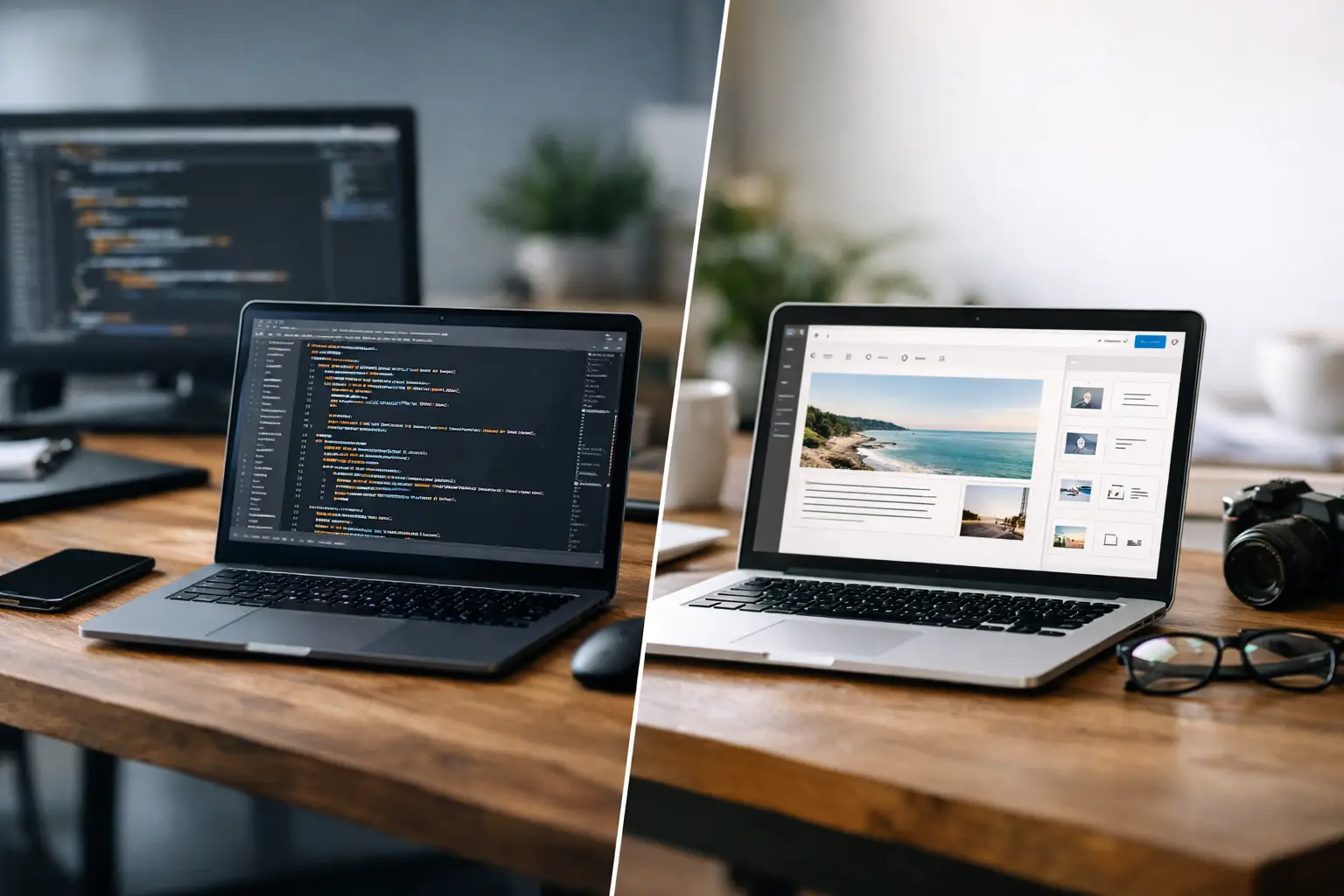
A website can look polished and still lose business. Slow load times, confusing service pages, hard-to-manage forms, weak local SEO, and disconnected lead systems all create friction between a prospect and a phone call. When comparing custom coded websites vs WordPress, the real question is not which platform is universally better. It is which option gives your business the best foundation to attract, convert, and manage more customers.
For a Tampa contractor, law firm, medical practice, or growing service business, the decision affects far more than design. It influences your marketing flexibility, long-term costs, website security, page speed, integrations, and your ability to make changes without creating new problems.
WordPress Is a Practical Starting Point for Many Businesses
WordPress powers a large share of business websites for a reason. It is familiar, flexible, and supported by a wide ecosystem of themes, plugins, developers, and content tools. For companies that need a professional website launched efficiently, WordPress can be a smart and cost-effective choice.
The platform is especially useful when your team plans to publish blog posts, update team bios, add project galleries, or make routine content changes internally. A well-built WordPress site can support strong SEO, responsive mobile design, lead forms, service pages, scheduling tools, e-commerce, and more.
The key phrase is well-built. WordPress itself is not the problem when a site underperforms. Problems usually start with an overloaded theme, unnecessary plugins, poor hosting, neglected updates, or a website assembled without considering the business’s sales process.
A local roofing company may need location pages, estimate requests, before-and-after galleries, review displays, and call tracking. A dental practice may need online forms, appointment requests, patient resources, and HIPAA-aware workflows. WordPress can handle many of these requirements when the site is strategically planned and professionally maintained.
Where WordPress Can Create Limits
The convenience of WordPress can become a liability when a business relies on too many third-party plugins to make essential functions work. Each plugin introduces another dependency, potential security concern, update requirement, and possible conflict with the rest of the site.
This does not mean plugins should be avoided entirely. Reliable plugins are useful tools. The concern is stacking them without a technical plan. A site that uses separate plugins for forms, pop-ups, page speed, redirects, reviews, scheduling, backups, analytics, image compression, and CRM connections can become harder to manage over time.
WordPress may also be limiting when a company needs a workflow that does not fit an off-the-shelf solution. For example, a home service business might want leads routed by ZIP code, service type, and crew availability. A law firm may need an intake process that qualifies cases before scheduling a consultation. A multi-location business may need location-specific content, reporting, and user permissions tied to internal systems.
A plugin may handle part of the job. Custom programming can handle the entire process.
When a Custom Coded Website Makes Sense
A custom coded website is built around your specific business requirements rather than the constraints of a prebuilt theme. The design, page structure, features, and integrations are intentionally developed to support how your company sells, serves customers, and operates behind the scenes.
This approach is often the right fit for businesses that need greater performance, specialized functionality, or deeper control over their digital infrastructure. Instead of adapting your process to available plugins, the website can be built to support your process.
Custom coding is particularly valuable when your website needs to connect with a CRM, quoting system, scheduling platform, payment processor, inventory database, customer portal, or proprietary internal tool. It can also make sense for businesses with complex lead routing, advanced calculators, member-only content, custom dashboards, or unique compliance requirements.
Performance is another major advantage. A custom site can be built with only the code and assets it needs. That can reduce unnecessary bloat, improve load times, and create a cleaner experience on mobile devices. Faster pages support user experience and can strengthen the technical foundation for SEO, especially when prospects are searching on their phones and comparing several local providers at once.
Custom does not automatically mean better, however. Poor custom development can be just as costly and difficult to maintain as a poorly configured WordPress site. The difference comes from the quality of planning, development standards, documentation, testing, and ongoing support.
Custom Coded Websites vs WordPress for SEO
Search engine optimization is not decided by a platform label. Google does not rank a website simply because it is custom coded or built on WordPress. It ranks content and pages that best meet search intent while delivering a reliable user experience.
Both options can perform well in search when the fundamentals are handled correctly: clear site structure, useful service content, localized pages where appropriate, fast loading, mobile usability, proper title tags, internal linking, schema implementation, and conversion-focused calls to action.
WordPress gives marketing teams a convenient way to create and optimize content at scale. That can be a significant advantage for businesses investing in ongoing SEO campaigns. A content manager can publish articles, update service pages, add FAQs, and optimize metadata without needing a developer for every edit.
A custom coded site gives developers more control over technical SEO details. Clean markup, structured data, image delivery, page templates, redirects, and performance improvements can be tailored to the site’s goals. This is valuable for companies with large websites, complex location strategies, or high-value lead generation campaigns where a small improvement in conversion rate matters.
The strongest choice is the one your team can maintain. An SEO-friendly website that never receives fresh content or technical updates will eventually fall behind, regardless of how it was built.
Cost Is More Than the Launch Price
WordPress generally has a lower upfront cost because common features can be configured rather than built from scratch. That makes it a sensible option for many small and mid-sized businesses that need a professional marketing site without a major custom development budget.
Custom development usually requires a larger initial investment. Planning, design, programming, testing, and integrations take time. But the higher upfront price can be justified when the website replaces manual work, reduces software subscriptions, improves lead handling, or supports a revenue-generating process that generic tools cannot manage well.
The better comparison is total cost over time. A lower-cost website that is slow, difficult to update, vulnerable to plugin issues, or unable to connect to your business systems can cost more in missed leads and repeated fixes. On the other hand, a highly customized website is unnecessary if your business only needs clear service pages, lead forms, reviews, local SEO support, and regular content updates.
Before approving either approach, ask what the site needs to accomplish in the next 12 to 24 months. Consider marketing goals, expected traffic, content needs, operational workflows, integrations, and who will manage updates. Those answers should shape the technology decision.
Security and Maintenance Need a Real Plan
Every website requires maintenance. WordPress sites need core, theme, and plugin updates, backups, security monitoring, and periodic performance checks. Neglecting those tasks creates avoidable risk, particularly for businesses that collect form submissions or customer information.
Custom sites also need ongoing attention. Server environments change, third-party APIs update, browsers evolve, and business requirements expand. The maintenance may look different, but it does not disappear.
The practical advantage of custom development is that there are often fewer moving pieces when features are purpose-built. The practical advantage of WordPress is that standard maintenance tasks are familiar to many qualified providers. In either case, businesses should know who is responsible for updates, monitoring, backups, recovery, and support when something fails.
Choose the Platform That Supports Growth
Choose WordPress if your business needs a flexible, content-driven marketing website, your feature requirements are relatively standard, and you want an efficient path to launch with manageable ongoing costs. With the right architecture and maintenance, it can be an excellent lead-generation platform.
Choose a custom coded website if your business has specialized workflows, important integrations, performance requirements, or operational challenges that standard tools cannot solve cleanly. It is an investment in a tailored business asset, not just a digital brochure.
Many companies do not need to treat this as an all-or-nothing decision. A WordPress site can include carefully developed custom functionality. A custom front end can also use an intuitive content management system so nontechnical team members can update key pages. The right solution often combines practical content management with programming where it produces a meaningful business advantage.
Mindful Coding Solutions approaches this decision from both sides: what will improve your marketing results, and what technology will make execution easier for your team. Start with the customer journey and the business process behind it. The right website is the one that makes it easier for qualified prospects to find you, trust you, and take the next step.